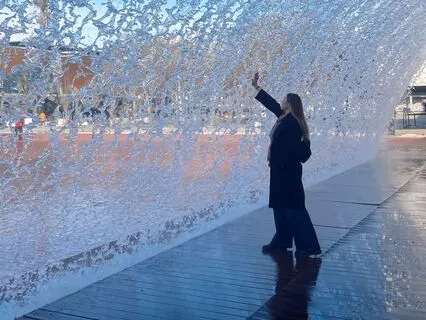
Side-to-side soft turn
Slow horizontal turns of the head, only as far as feels easy, returning to centre between each turn.
A small library of practices for the neck, shoulders, and upper back — short, optional, and shaped to fit between everything else you're already doing.
The neck holds the day in subtle ways. These practices are short and slow, designed to invite ease without strain or sudden range.
Slow horizontal turns of the head, only as far as feels easy, returning to centre between each turn.
Look down and slightly to one side, letting the back of the neck lengthen quietly. Switch sides.
From shoulder to centre to shoulder, the chin draws a slow soft arc across the chest. Never a full circle.
Sit upright, eyes soft, simply notice the neck's resting state. No movement is also a practice.
The upper back often quietly carries posture habits. These practices invite a soft re-distribution of attention across the shoulder line and ribs.
Imagine the shoulder blades sliding gently down the back, away from the ears. Soft, no effort.
Bring the hands behind the lower back, lift the chest gently. Three quiet breaths.
One arm lifts toward the ceiling, the other rests, switch slowly. Lengthen rather than stretch.
For seated work, the lower back appreciates micro-shifts more than long stretches. These practices favour subtle change of position over forced range.
Tilt the pelvis softly forward and back, finding a comfortable middle. Three slow cycles.
A gentle rotation through the upper torso, hand to opposite armrest, eyes following slowly.
Stand, walk slowly to a window or kitchen, walk back. Movement disperses lingering tension softly.
Cross one ankle over the opposite knee, hinge slightly forward at the hips. Switch sides.
When attention has narrowed for a while, a short neck or shoulder practice can soften the transition out.
The minute or two between calls is a natural pause for a slow chest opener or a brief stand-and-settle.
A loading screen, a kettle, a queue — small in-between moments are quiet invitations for micro-movements.
A slow lengthening sequence helps mark the close of focused hours and the start of softer evening time.